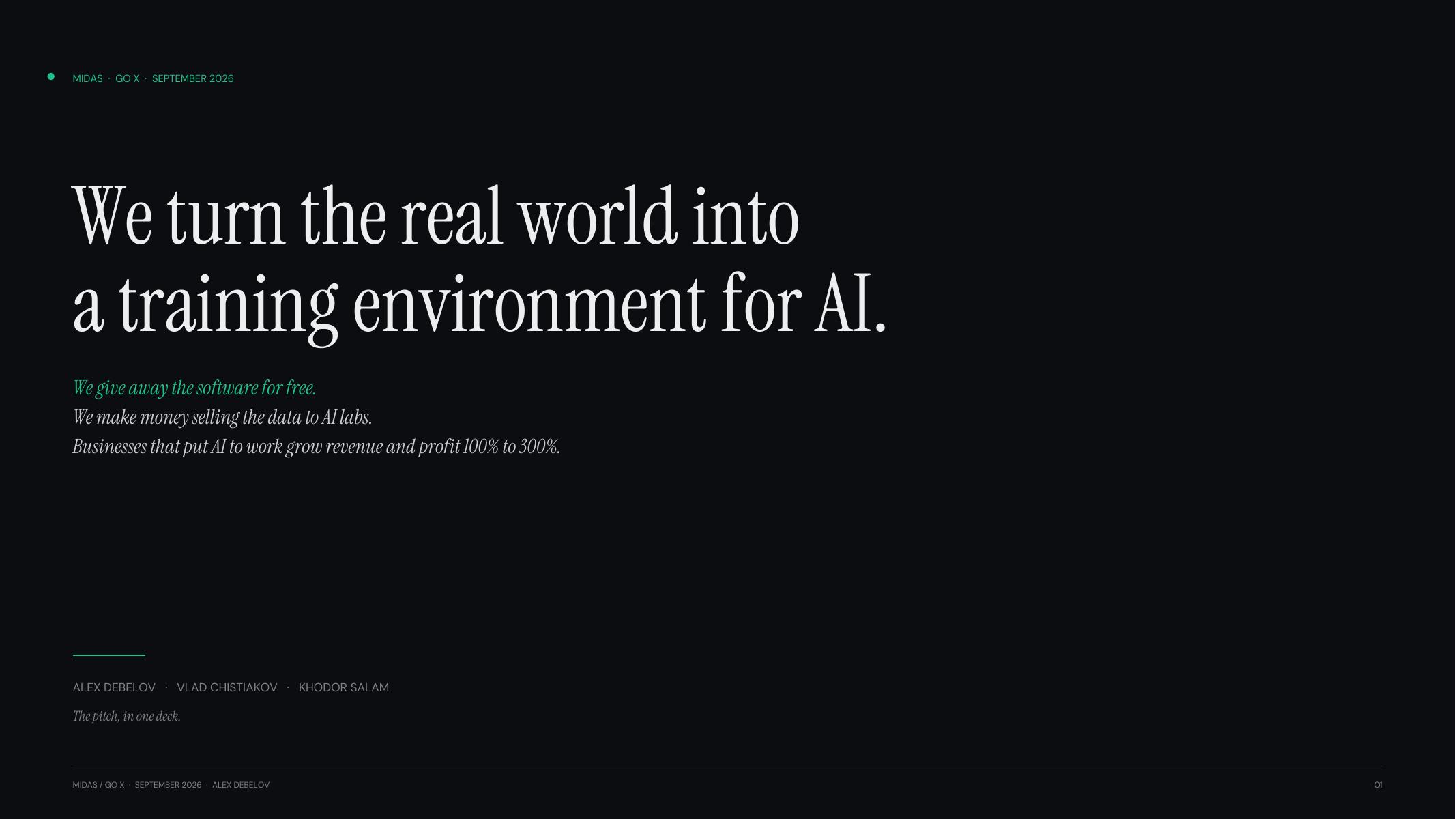
Free software for the businesses. Paid by the AI labs. First body: Go X. 20,000 scooters. 30+ cities. All run by AI.
Write your memo. Review your PR. Translate a website. Summarize a meeting. Answer a customer email in three languages.
Every frontier model was raised on text, code and screenshots. It became a better version of what it already is: a thing that lives inside a computer.
Run a business. Sign a venue at 6 PM on Friday. Price a shift when it starts raining. Dispatch a driver whose van just broke down. Take the hit when it's wrong.
That's not a smarter chatbot problem. It's a data problem. There is no internet for physical operations.
AI has read every book on tennis. It has never held a racket. Go X is the racket.
Labs are paying eight figures for dead reality. Live reality is not yet for sale.
Sources: Bloomberg Law, Axios, TIME (Aug 2026) · Forbes (Apr 2026) · Epoch AI RL environments FAQ
One $500K training run on the corporate-law world took a lab's bench from 4.7% to 26.6%. The price of a world is what it's worth to the next benchmark point.
Prices from public statements by Mechanize, Mercor, AfterQuery, HUD, and Deeptune, Sept 2026 · Bench delta from Epoch AI.
Value per data point rises left to right. The last bar has no price because nobody has built the supply. Pricing from Epoch AI, Forbes (Apr 2026), Bloomberg Law, Axios (Aug 2026).
A training gym is where a model practices before it goes to production. Three camps disagree on what a gym is.
First two teach the model about reality. We let it touch reality — and grade it on what happened.
Not scooters dumped on sidewalks. A network of hotels, resorts, bars, marinas and campuses hosting the fleet on their property. No permits. No tenders. No caps. First to launch self-driving scooters, in 2018.
And that's not what it is anymore.
That's a dataset.
130+ city launches. 5,000+ venue negotiations. A new regulator every city. Every ride, refund, refuel, dispatch, permit call and midnight complaint becomes a data point the labs can't buy anywhere else.
This is what Midas produces every day. Multiply by twenty thousand scooters, thirty-plus cities, three years of operation, and you have the training set no lab has.
One episode. One override. One reason logged. One reward. Times a hundred a day.
Stripe, POS, dispatch, calendar, phone, Slack. Owner signs consent once.
Every task on the ledger. Quotes, routes, refunds, hires, prices, outreach.
Tap yes. Or change it. The change and the reason get logged.
Money moves. Reviews come in. Permits clear or don't.
Every override and every reward becomes a lesson. Sold non-exclusive.
Five steps. Every task. Every business. Every day.
Cameras, GPS, IoT, transactions, messages, weather, machines, inventory
One snapshot of the business at the moment of decision
Any lab's model, or ours. Proposes the action.
Human approves or overrides, then routes to:
What happened
Stripe, dispatch, pricing, messages
Field techs, cleaners, drivers, ops leads
Carts, drones, vehicles, later
Money, uptime, SLA, safety
Train again: every override and every reward goes back into the model
Every operation becomes state, action, outcome, reward. That's the asset.
The same interface serves a lab's model in shadow mode, our agents in production, and a robot in three years. The actuator changes. The loop doesn't.
Every task in the amber band is a labeled example at the exact edge of what models can't do yet, with the outcome attached. A task graduates to green when the override rate drops near zero. Coverage rises, overrides fall, and the band stays fat on purpose.
Agents propose everything. Humans approve everything.
The number we publish every month, per vertical: how many of the 100 the agents ran alone. That's OpsBench.
Every task it takes to run a scooter business, scored today. Twelve the agent runs alone. Thirty-three the agent proposes and a human approves. Fifty-four still human. One that stays human forever.
The amber band is the dataset. Every one of those 33 tasks is a labeled example, at the edge of what models can't do yet, with money attached.
Go X is not a pilot. Twenty thousand scooters, thirty-plus cities, million-plus riders, since 2018. Every other environment vendor is buying customers to run their gym. We already have them.
The state, action, reward interface is the same for scooters and cleaning and moving and restaurants. The actuator changes. The loop doesn't. That means the second business is not a rebuild.
We don't invent rewards. Money grades. Reviews grade. Permits grade. The reward function is the world, which is exactly what the labs can't fake and can't afford to skip.
Nobody at scale, with consent, packaged for labs. Owners sign data rights on day one. De-identification is tested against re-identification. Legal gate before any export.
Forty-three pages. The frame, the deal, the proof, the ledger, the field and the ninety-day plan. The same argument as this page, built to read on a plane.
The whole thesis rests on one claim: a real operating company can be turned into something a frontier lab trains against. So we did it to our own company first, and published what a lab receives.
The reinforcement-learning environment built around Go X. Eight years of invoice-linked receipts, forty-seven tasks, a simulated ledger held within ten percent of the real one, and a leaderboard where the human still wins. This is what “understand how it works” looks like in practice.
Open the gym ->The environment spec, the fidelity gate, the task families and the rights posture. Read it beside the pitch deck above: one is the argument, this one is the receipt.
See the build ->Give the software away. Sell what the brain learns to the labs. Every real business becomes a classroom. Every owner's correction becomes a lesson.
Alex Debelov · Midas / Go X · September 2026